Over
the last five hundred years, the primary source of value add, and thus
profits, has gradually moved from production and delivery of raw materials
and commodity intermediate products to production and delivery of finished
goods (with the notable exception of petroleum). At the turn of the
millennium, a similar shift is occurring from finished goods to production
and delivery of information. The prior transformation saw few companies
retain their former pre-eminence, and many countries experienced major
changes in relative prosperity and influence.
Over the next decade, the key
issue for current providers of finished goods (including finished goods
that are largely information, like music) will be their ability to
visualize and pursue an effective strategy for optimizing information flow
and value from the end consumer back through their value chain. Many of
the successful companies of tomorrow that do not own the brand or design
process, will recognize their position in the value chain and act as
specialty services providers to a number of companies across the value
chains in their ecosystem(s). The matrix below illustrates the “Disrupt or
Die” imperative facing most companies.
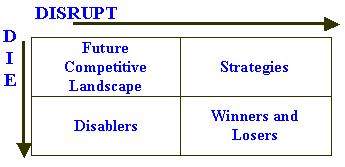
Future
Competitive Landscape
The
shift from raw materials to intermediate products to finished goods
resulted in creating new sets of winners with each transformation. Early
evidence indicates that the shift to information management as the key
value add may have the same result: for every company that transcends the
limits of its industry to become a key player in information management,
there are numerous newcomers (Vodafone; Amazon; Solectron) whose absence
of legacy baggage allows them to fill new positions quickly in their
ecosystems. Executives in many industries indicate a greater fear of the
well-equipped outsider than of their traditional competitors. This fear
appears to be valid – traditional industry definitions are being made
obsolete by the development of ecosystems made up of value chains
delivering products/services that fill a similar customer need (for
example, the mobile communications ecosystem filling the need for
anytime/anywhere two way information exchange).
Speed
appears to be a critical competitive advantage in the transformation
equation. Different industries – indeed, different countries – have
different ‘clock speeds’ as described in Clock Speed, by Charles
Fine. When new ecosystems cross several traditional industries and
geographies, the players with the fastest clock speed are capturing the
majority of the value add in the value chain. In mobile communications,
the traditional telcos are losing out to the new backbone companies,
service providers, and content access specialists; and where regulatory
barriers are being reduced, local companies are losing to Anglo-Saxon
based entities.
Early
indications are that geographic stratification will develop based on
comparative advantage. Some examples already becoming evident are:
·
“Generic”
manufacturing in greater China, to utilize the size, education and work
ethic of the work force, and the entrepreneurial skills of the Chinese
diaspora;
· Service
centers in Ireland, Holland, and India;
· Tax
advantaged assembly in Mexico, Ireland (pending an EU crackdown), and
eastern Europe;
· Branding
and design in the United States and Japan
· Fit
in geography and
accept the way things are done and will probably not have competitive
differentiation;
· Leverage
the strengths and characteristics of geography to anticipate where it’s
going, and position yourself ahead;
·
Fight
to overcome the barriers and disabler characteristics of that geography;
·
Flight
by either going to a different geography, business, or ‘greenfield’
approach and give up on changing existing business.
The
rise of specialty service providers within an ecosystem leaves companies
that do not own brand or design with two options: to compete or to
leverage. Companies can continue to keep business processes internal (core
competencies and other) and go up against the specialty providers, or
instead, sell off non-core competencies as a means of leveraging the
efficiencies and expertise of specialty service providers, and freeing up
capital.
The gap in
intrinsic growth rates among countries will continue to expand, with
countries that have mobile labor forces, heavy reliance on explicit
knowledge, and minimal employment barriers being able to sustain a
consistently higher growth rate without adverse consequences such as
inflation. At a company level, similar concepts will apply, with some
caveats regarding the value of employee loyalty in maintaining
institutional culture.
Strategies
The
research suggests that there are numerous strategies that can assist in
positioning a company in a value add role within the new ecosystem(s).
Some examples found today are:
· For
companies that own the branding or design activities within a value chain,
focus on those competencies and utilize best of breed providers in the
value chain to perform other activities. Act as a ‘control tower’ to
monitor and manage the value chain; do not abdicate responsibility for the
activities that move outside the company boundaries. Based on a fairly
small sample, companies executing this strategy achieve greater
flexibility and speed in reacting to market changes; improve return on
capital while reducing risk; and obtain channel advantages vis-à-vis more
vertically integrated competitors.
·
Companies that
provide utility products or services (i.e., own neither the brand nor the
design) appear to maximize growth and profits by maximizing coverage
across all the value chains in an ecology. These companies benefit from a
narrower but deeper focus that results in performing fewer activities in
house, but performing them better. For example, the Taiwanese
semiconductor foundries and PC component manufacturers are increasing
market share and profits by targeting as many value chains as possible
within an ecosystem.
·
Where a
company owns customer access, providing a branded portal that fully meets
customer needs for product information and purchase decisions has proved
successful across many industries (Dell; Sabre; [Progressive Insurance]).
Access to competitor products through a company’s portal transfers some of
the power of the brand to the owner of the portal. Strategies that limit
product access through a portal to a company’s own offerings appear to be
losing competitive positioning in the marketplace. This strategy becomes a
differentiator at a country level where country laws discourage or
prohibit multiple providers or discounted pricing through a portal (e.g.,
Germany).
· Several
Japanese companies have recognized, serendipitously or otherwise, that
partnerships with companies who’ve already adopted new value chain models
(all of which are currently U.S.-based), provides a transfer of knowledge
and capabilities into their own operations (NEC/Cisco, AOL/NTT DoCoMo).
This strategy has been proven successful for companies located in North
America in need of transformation, by forming partnerships or acquiring
U.S.-based companies (Nortel Networks acquired Bay Networks to serve this
purpose).
The
companies that will be most successful in the new era of information
management will be those that own both brand and design, and that focus on
those two areas as the levers to transform their value chains. Those
companies, however, are the least motivated to lead such a transformation,
based on the results of the research to date.
Disablers
The
research identified several major barriers to value chain transformation
that are particularly strong in East Asia and Europe. Individually, the
barriers present major difficulties; collectively, they may be
insurmountable:
·
Companies rely
heavily on the implicit knowledge of their workforces, as the tradition of
long-term employment has historically permitted companies not to invest in
documenting processes extensively. Successful companies will select their
core competencies and develop explicit documentation for the remaining
processes (i.e., claims processing in insurance companies) that enables
rapid transfer of a portion of business process to a specialty services
provider in the value chain. While this finding is strongest in East Asia,
it also applies in southern Europe (for example, Italy).
·
Society
accepts the legitimacy of government involvement in business decisions.
Governments are inherently resistant to disruptive change (with the
exception of Singapore), and create formal and informal barriers to
prevent companies within their jurisdictions from implementing such
change. In continental Europe, this takes the form of a social safety net
with associated costs to employers that makes large scale shifting of
employment within the value chain infeasible; together with government
partial ownership of or influence over major industries such as
telecommunications. In Japan and much of the rest of East Asia, the
control is exercised through government influence over capital allocation
through direction of the banking industry.
· Other
non-executive stakeholders (besides the government) are also typically
opposed to disruptive change, and in much of continental Europe have the
power to prevent such change. Examples include union membership on the
supervisory boards of German companies; heavy bank and insurance company
ownership of shares in Germany and Japan; the system of cross-holdings to
consolidate preferred partners in France, Italy, Japan, and elsewhere; and
the informal networks among the overseas Chinese entrepreneurial
companies. The corollary to the influence of external stakeholders is the
relative weakness and lack of accountability of the CEO position in
countries such as Japan, which prevents the CEO driving change from the
top down.
·
Both Europe
and East Asia have business and societal norms that focus more heavily on
punishing failure than on celebrating success. Executives who protect and
preserve their companies, and maintain an ‘appropriate’ profile, are more
respected than those who take risks, even successful risks. Failure shames
both the individual and the company. The major exception occurs with
Greater China and the overseas Chinese community, where risk taking is
accepted, but seeking a high public profile is not. The businessman as
hero is a uniquely American concept.
·
East Asia has
two unique challenges:
4
The
opaque ownership structure and weak corporate governance make valuing
portions of an enterprise challenging, and thus separating out an activity
and associated assets when restructuring a value chain is more difficult.
Trust is difficult to establish between arms-length entities due to the
lack of visibility into these companies. Japan represents a partial
exception; and within the Greater China community the guanxi networks
provide a trusted substitute for corporate transparency for value chains
that are entirely within that community.
4
While
much of East Asia is suspicious of the North American way of doing
business, and believes in an “Asian values” alternative, there has not
been an indigenous success story others can copy. Without a demonstrated
viable alternate model, East Asian companies are left with no clear
direction on how to achieve information-intensive value chains within the
constraints of culture and infrastructure.
The
barriers identified by the research appear to prevent an established
company in either continental Europe or East Asia from acting as the
driver for transforming its value chain. Companies in greater China appear
to be well positioned to become participants in new value chains in
secondary roles, based on the flexibility and willingness to take risks of
these still largely family-controlled enterprises.
Winners And Losers
The
characteristics correlated with success and with failure suggest that
established companies based in Europe or East Asia will need to follow one
of three strategies to succeed long term in the Information Age:
Create a
new, ‘greenfield’ company that is independent of any ongoing management
involvement from the parent company, and that is chartered and staffed to
act either as a value chain transformation driver, or to fill a specific
role across several value chains within a particular ecosystem.
