Initial
Position
Given all
that has been stated above regarding Global 5000 companies’ ability to
transform, we posit several reasons that they have not been able to
transform thus far. First and foremost, lack of senior executive support
of transformative initiatives, which almost always involves technology, is
a major barrier to success. If the Internet is considered as a proxy for
pervasive, real time information availability along the value chain, then
this finding explains some of the lack of enthusiasm on the part of CEOs
to invest heavily of their own time and their company’s resources in
transformation initiatives.
Secondly,
each region, Western Europe and Asia Pacific, face different barriers
based on where they are in terms of technological infrastructure,
governmental infrastructure (independent institutions for corporate
governance, etc.) and policy, and financial institutions and
infrastructure.
North
America is substantially ahead, not just chronologically but structurally
(government, unions, capital markets, corporate governance, competitive
nature of economy). Europe today is focused on improving infrastructure,
when what they require is improved governance structures. Implication:
Europe is not 2 years behind North America – it is structurally impaired
versus North American and will not be able to leverage information
abundance as well.
Asia
Pacific is not a single entity, as each country is remarkably different
from the other in its current position. On the whole, these counties are
more behind than Europe, but more willing to adopt unconventional
approaches to catch up (Japan), invest heavily in infrastructure (Korea,
Singapore) or accept secondary roles (for now) in transformed value chains
(Greater China).
Much has
been made of the infrastructure advances in wireless (Europe and Japan),
broadband (Korea), and pervasive access (Singapore). These claims confuse
transport with product, as described in Finding 3.
Findings
1)
Established companies are organized and governed to accomplish incremental
business model changes, not disruptive changes. Only long-term persistent
CEO leadership has the potential to drive the necessary company and value
chain transformation required to leverage information abundance.
In East Asia, for many counties, the government has considerable
influence over the business and is tied in through various investments,
etc. In China, many of the industrial corporations are State Owned
Enterprises (SOE), which typically consume more capital than they are
able to produce, accounting for 80% of the countries bank loans. Within
the SOE’s there are often layers of subsidiaries underneath, run by
elites who typically pay themselves for dubious services, then report
losses to the holding company (1). These families dominate the SOE’s and
are not held accountable to anyone, as there is not an independent
corporate agency to act as an adversary. It is difficult to lead a
company through a transformation when the leaders are not the people
with power and those with power are not incented to change.
Leadership style to transform the value chain is a major factor in
success or failure of the initiative. Key attributes for a leader
undertaking this type of initiative is:
·
Willingness to make decisions with very little information
·
Knowledge of human motivation, proper incentive programs in place, provide
your best people with authority and autonomy
·
Radiate and support a vision
·
Goal focused versus process focused
The small percentage of companies that have successfully transformed,
have all had the executive support and drive to take them there.
‘Greenfield’ companies do not face this obstacle, but often do not have
the leverage that comes with ownership of the brand to transform their
value chain.
For companies based in France, where the country is heavily
bureaucratic, highly-centralized and run from the top down, it is next
to impossible to create the type of environment, such as Charles
Schwab’s, where leadership is instilled within employees at all levels
of the company.
Leadership in Germany is also difficult because of the dilution of CEO
power due to:
·
Union involvement on supervisory board;
·
German government involvement on the state and federal level;
·
And a cultural tradition that mitigates against high profile executives.
2)
A small
percentage (1-2%) of the Global 5000 have actually accomplished or are
well along towards accomplishing value chain transformation utilizing
information abundance as an enabler.
Companies whose products incorporate substantial technology, and whose
products are heavily used by the high tech and telecommunications
industries, are heavily represented among the success stories. Several
information intensive industries (e. g., health care delivery;
insurance) have essentially no major successes. What successes exist are
largely North American based.
Furthermore, in Europe, companies based in the U.K., France, and Germany
have more trouble implementing pan-European strategies because of
traditional national prejudices/animosities by many countries towards
these three. Companies that have the capital structure and mass to
transform industries/value chain pan-European are predominately in UK,
France and Germany. Therefore, the pan-European value chain
transformation is hindered by the lack of adequately capitalized players
without historical baggage.
For those companies based in European counties, capital will be sparsely
allocated to non-traditional players, and most investors will only fund
start-ups that have a detailed, long-term strategy in place. In
comparison, many North American investors fund start-ups without
long-term plans that have the management teams in place that have the
ability to react to disruptive change and make quick decisions to move
forward.
3)
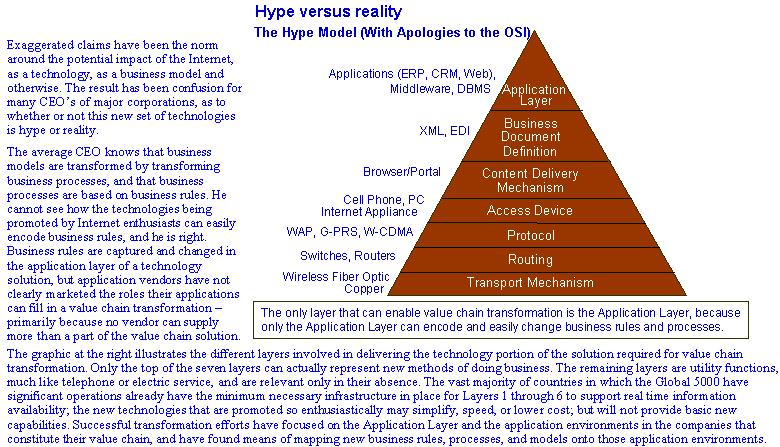
Almost
two thirds of CEO's consider the business change potential of "the Web" to
be more hype than reality, due in part to exaggerated and unrealistic
claims by proponents. Many CEOs (and other Cxx officers) do not
distinguish between the technology enablers (the Internet; XML;
middleware) and the outcome (abundant, complete, pervasive, real time
information availability across a value chain).
Given the success stories that exist for value chain transformation in a
variety of industries, this skepticism on the part of two thirds of CEOs
might appear puzzling. Further discussions have shed some light,
however, on the caution with which senior executives to the assertions
of the proponents of the change potential of the Internet. Three factors
appear to elicit the negative executive reaction:
·
The focus
on technologies on the part of proponents:
4
Wireless
technologies, such as cell phones, wireless protocols (WAP, GSM, GPRS, W-CDMA,
3G wireless), Internet appliances
4
Backbone
technologies, such as fiber optics, switches, routers
4
New
Internet conventions and tools, like XML and others too numerous to
mention. As much of this hype is promoted by vendors selling products, the
focus on technologies is understandable, but the average CEO has had
enough “silver bullet” technologies fail to deliver promised benefits
(think client/server or ERP) to be rightly resistant to such claims.
·
The lack
of any plausible causal explanation of how the hyped technologies tie to
what the CEO knows are the critical success factors of his business – how
does an Internet-enabled cell phone in the hands of every Scandinavian
reduce his company’ working capital requirements? Improve gross margins?
Speed time to market?
·
The sheer
messianic intensity of many of the proponents appears to most executives
more appropriate to a new religious cult than to a business setting.
4)
USA and
Canadian companies are disproportionately represented among
global players leveraging information abundance.
Not
only have virtually no European or East Asian headquartered companies
achieved the value chain transformation; but the number of such
companies currently attempting transformation, even in their home
geographies, is less than the North American-based companies with
initiatives in those geographies. The one exception appears to be some
Taiwanese manufacturers, but they may be driven by requirements of their
U.S.-based customers.
In both
Western Europe and Asia Pacific, the culture that pervades is one that
does not celebrate success and punishes failure, discouraging executives
from high risk, high reward initiatives. In North America, particularly
the U.S., failing in a job and reinventing one’s self is part of the
culture; in both Europe and Asia Pacific, it is inconceivable. Stock
options are used in North America to provide rewards commensurate with
risk and motivate employees, but in Western Europe, stock options are
less practical because the laws and customary practice are not
supportive. Europeans view their family, vacation time, and regular work
hours as a high priority and thus far have not developed the culture and
enablers compelling enough to move them from their secure high paying
jobs, to opportunities with high risk and potentially little reward. A
value chain transformation is inherently disruptive, requiring that
management and employees are properly incented to execute the change.
5)
The
owners of the brand and of product/service design have the
greatest leverage in transforming the value chain and extracting
disproportionate profit.
Manufacturing and financing/capital provision no longer generate above
average margins, except during capacity constrained periods in a
business cycle. Companies interested in maintaining consistently high
margins and return on capital (which tend to be more important
motivators for U.S.-based companies) are increasingly using third
parties to perform activities that have lower margins or employ more
capital, as a way of overcoming internal barriers and resistance to
value chain transformation.
Several country-specific strategies in East Asia today:
4
Japan continues to stay strong in branding and design while leveraging
North American firms to help with the transformation.
4
Greater China has temporarily accepted secondary role in the value chain
transformation and will participate if driven by external factors, such as
North American customers and foreign investors.
4
Korea is still following Build-to-Order manufacturing, running as
autarchic companies and focusing on infrastructure rather than the
customer.
4
Australia is relatively comfortable with where they are as a raw materials
supplier except for a few leading companies, such as BHP.
View the
Broken Hill Proprietary
Transformation Initiative
6)
Certain
companies and cultures are attempting to partner with firms that have
accomplished a value chain transformation, to obtain a kick-start or
“piggyback effect:” DoCoMo with AOL; NEC with Cisco; Mitsubishi with
Inktomi and others.
East Asia is looking to the United States to serve as a hub to Internet
technology and IT that will transform their value chains and bring them
up to speed through partnerships. A recent example of such partnerships
occurred in September of 2000, between Japanese company NTT DoCoMo and
U.S.-based AOL, to jointly develop and market mobile-Internet services
in Japan and elsewhere. AOL Japan, Inc. will be the center point for
future investments and innovative Internet mobile services, owned and
controlled mostly by parent company, AOL and NTT DoCoMo.
The Cisco-NEC relationship aims to expand globally expand the
collaboration the two companies have historically demonstrated at a
regional level. In Japan, NEC has a broad OEM arrangement with Cisco,
providing joint solutions to the market. In the United States, NEC is
one of the largest system integrators for Cisco; and in Australia, NEC
and Cisco operate under a joint marketing agreement.
Inktomi and Mitsubishi have formed a partnership to bring Internet
infrastructure into Japanese companies. As spoken by Koichi Kobayashi,
corporate vice president, from Mitsubishi Electric Corp, "believe
Inktomi's cache technology and portal products and services are keys
ingredients for the next generation Internet and we expect to launch
Traffic One Communications, our new Internet business subsidiary in
early October to leverage these technologies,"
7)
Implicit
knowledge especially in conjunction with lifetime employment is a barrier
to value chain transformation. Explicit knowledge in highly mobile labor
forces is an enabler.
How
does a company undertake a value chain transformation if it operates
using the implicit knowledge in the heads of its employees, rather than
explicit documentation? The answer is, it doesn’t. A company that
operates under implicit knowledge relies on handshakes for contractual
agreements, as many of the companies within the Chinese guaxni networks
do, rather than a legal-binding document with terms of agreement. Most
East Asian companies and institutions operate through implicit knowledge
rather than explicit: witness China’s most recent reaction, as described
by The Economist, to the rules for entering the WTO, where the “Chinese
argue that no member should be subject to more than the WTO’s existing
rules, and insist that “mutual trust” and “mutual confidence” ought to
be enough.”
How
easy is it for a company to then break a contract with one of its
suppliers or vendors to re-orientate itself in the value chain based on
new initiatives? It cannot. Furthermore, employees with the implicit
knowledge are operating under the assumption that they will perform that
particular job for an extended period of time and there is very little
mobility. All of the knowledge that the single employee has gained is
kept within his/her own mind, making it difficult to shift, replace or
add new employees to fill that role.
“It is difficult bordering
on impossible to lead a company through transformation when leaders are
not the people with power, and those with power are not incented to
change.
Corporate governance
structures in Northern Europe, Japan and mainland China prevent the
required accumulation of power at the CEO level to drive value chain
transformation.”
8)
Most
ecosystems in North America have at least one value chain dominated by a
company able to transform the value chain. This is typically the company
with the brand or design presence and the initiative to undertake the
transformation.
This
suggests that North America will produce most of the global leaders in
the new ecosystems that are supplanting traditional industry boundaries.
When an ecosystem leader fails to seize leadership, the second or third
place company can step in.
The
element present in most North American based ecosystems, and incomplete
elsewhere, are a variety of specialized firms focused on performing only
one or a small number of activities within a value chain, but performing
these activities for many value chains across an ecosystem.
Incorporating these firms into a value chain permits the owner of the
brand/design greater flexibility, dramatically reduces the capital
required to operate, and encourages management to focus on the highest
customer value add activities. Within North America, only a few
regulated or formerly regulated industries/ecosystems (such as
traditional telephone operating companies) have the full range of
specialty firms but lack any branded player willing to lead value chain
transformation.
9)
Each
region has specific barriers:
Asia
Pacific:
·
Lack of
information transparency (will change to please foreign investors)
·
Lack of
accepted corporate governance standards and accountability
·
Government influence on financial sector and capital allocation
·
Lack of
an “Asian” business model (Japan, China and Taiwan, etc. All have their
own models)
·
Government regulation protects status quo and discourages innovation
4
Example: NTT
4
Competition Policy favors established companies (chaebol in Korea,
kieretsu in Japan, etc.) Exceptions: Taiwan and Hong Kong (pre-China
return)
·
Family
dominated businesses rely on implicit knowledge and have thin management
teams. Relationships with other firms rely heavily on “guanxi” which is
hard to computerize
·
Most
Asian cultures do not support high profile success and condemn failure
Europe:
·
Government emphasis on information management leads to regulations that:
4
Discourages business from sharing information;
4
Creates
high compliance costs;
4
Insists
government access to company information; and
4
Causes
a reluctance to establish operations in these counties.
·
Existing stakeholders who will be adversely impacted by change (unions,
alliance partners, regulators, mgmt) have power to block change.
·
Failure
is punished more than success is rewarded.
·
Upside
for top management is limited – reduces willingness to take risks
·
Capital
sourcing practices have created cross holdings and grouping of business
around the capital provider on the Continent. This makes structuring
value chains that cross groups harder than value chains within
groups, even when the former is more effective.
