The
last two years have witnessed an explosion in the pervasiveness of real
time communications and data sharing capabilities that transforms the
ability to conduct business in the 21st century as completely
as the telegraph, railroads, and electricity did in the 19th
century. There has been a similar explosion in the body of literature
promoting improvements that can be attained at the company, value chain,
country, or global level from leveraging these new capabilities. Examples
showing how companies are achieving breakthrough results in their cost
structures, capital utilization, and revenue growth are commonly cited as
proof of the potential of ubiquitous real time information. Rare is the
executive who does not publicly proclaim intent to improve business
operations through use of the Internet.
Missing from discussions to date has been any thorough analysis of why 99%
of the Global 5000 has not realized material benefits from the value chain
improvements possible with real time information abundance. For every
Cisco, Federal Express, Amazon.com or Nike, there are a hundred
companies/value chains continuing with business as usual. Is this simply
the normal delay in adoption of new capabilities, or are there fundamental
cultural or management issues that will inhibit most firms from completing
a restructuring and streamlining of their existing value chain(s)? In
particular, are companies headquartered outside the USA more constrained
by stakeholders – suppliers, customers, controlling shareholders, unions,
management, government, and alliances – with a vested interest in the
status quo? If so, does this imply a competitive opening for sufficiently
agile American companies over the next several years?
This
research initiative investigated the readiness of the executives who set
direction for Global 5000 companies that are headquartered in Western
Europe and Asia Pacific to sponsor the changes required to maximize value
chain effectiveness over the next five years. In particular, the study
examined the impact of existing stakeholder networks on the ability of
these executives to drive major change in their corporation. As a
corollary, the research team considered the effect on competitive
positioning in select information-intensive markets and industries for
companies that are and are not able to transform their value chains
effectively. Where there are strong geographic differences, such as
greater willingness to change by U.S.-based firms, the research considered the
impact on international competitiveness of the major countries surveyed.
willingness to change by U.S.-based firms, the research considered the
impact on international competitiveness of the major countries surveyed.
Industrialized capitalist societies have developed a number of mechanisms
for aligning the interests of multiple companies to increase
effectiveness. These mechanisms range from powerful but informal long term
relationships ('guanxi' networks among the overseas Chinese; favor
exchanges in the American high tech startup ecosystem); to shared minority
interests supplemented by close personal ties among executives (Mediobanca
in Italy; the kiertesu in Japan); to effective formal control through
minority crossholdings (French industry; the evolving model for Korean
chaebols). Historically, these mechanisms have been viewed as means of
mobilizing the scarce resource of the day — capital — in the interests of
the companies participating. Indeed, there has been some weakening of
these structures with the financial deregulation required by recent trade
agreements, combined with the improved democratization and availability of
capital.
These groupings served to mobilize another, less well understood resource,
however: information. In the era of information scarcity that has
characterized industrial society since its inception, these groupings
conferred a competitive advantage through better accumulation and access
to information for the participating organizations. As the industrialized
world transitions to an era of information abundance over the next decade,
the existing structures (designed to hoard and allocate a scarce resource)
risk becoming a competitive disadvantage for the member companies. Where
management restructures based on the narrow view that the groupings served
primarily to mobilize capital, the result may be new modes of organization
that use information inefficiently, and that consequently are vulnerable
to challenge by both innovators and more nimble established competitors.
In the
United States, at least one community is beginning to grasp and act on
this concept. As venture capital became an abundant commodity, the high
tech startup world, including the service industries supporting it,
initially re-formed around communities able to supply the information
(legal, consulting, financial, personnel, etc) required for a startup to
succeed, but now is evolving towards an open market for services and
information. Several of the major trading exchanges are also implicitly
moving participating companies towards a mindset of information
availability and abundance, and in the process redefining the groupings of
companies that constitute their value chains.
Outside of the United States, there is slim evidence of similar changes.
Does this simply mean that executives in Europe and Asia Pacific are
slightly behind but on the same development curve as U.S. companies, or
are there fundamental executive mindset issues in those countries that
will make it difficult to replace existing groupings of companies with new
mechanisms that respond to the era of information abundance?
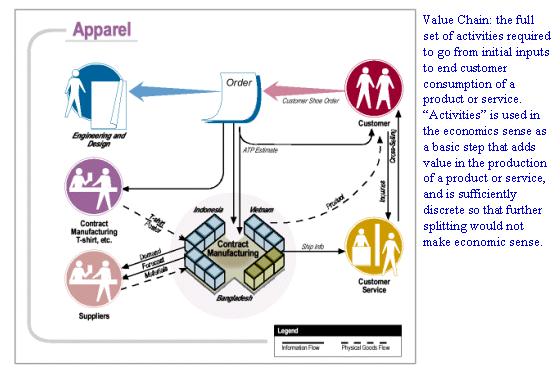
A
large apparel company provided customers with design to order capabilities
for shoes via the Web, with all activities required to process and fulfill
the order occurring at other companies in the value chain.
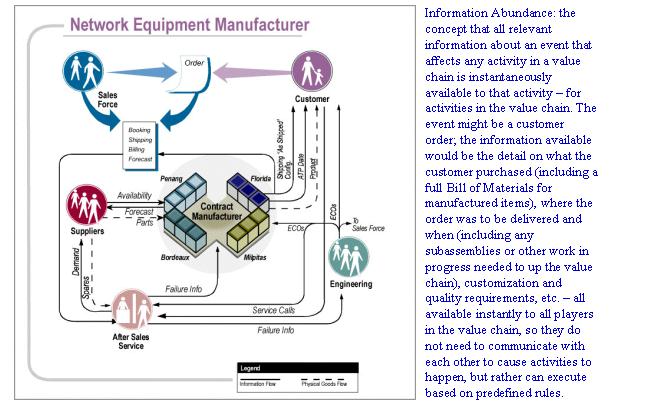
A major Telco
equipment provider achieved improved customer service and order of
magnitude reductions in working capital for their data networking products
by moving all physical product and parts handling, including service,
elsewhere in the value chain.