1.
Established
companies are organized and governed to accomplish incremental business
model changes, not disruptive changes. Only long-term persistent CEO
involvement has the potential to drive the necessary company and value
chain transformation required to leverage information abundance.
2.
A small percentage (1-2%) of the Global 5000 have actually
accomplished or are well along towards accomplishing value chain
transformation utilizing information abundance as an enabler. Companies
whose products incorporate substantial technology, and whose products are
heavily used by the high tech and telecommunications industries, are
heavily represented among the success stories
3.
Almost two thirds of CEO's consider the business change potential
of "the Web" to be more hype than reality, due in part to exaggerated and
unrealistic claims by proponents. Many CEOs (and other Cxx officers) do
not distinguish between the technology enablers (the Internet; XML;
middleware) and the outcome (abundant, complete, pervasive, real time
information availability across a value chain).
4.
The owners of the brand and of product/service design have the
greatest leverage in transforming the value chain (and extracting
disproportionate profit). Manufacturing and financing/capital provision no
longer generate above average margins, except during capacity constrained
periods in a business cycle.
5.
Certain companies and cultures are attempting to partner with firms
that have accomplished a value chain transformation, to obtain a
kick-start or “piggyback effect:” DoCoMo with AOL; NEC with Cisco;
Mitsubishi with Inktomi and others.
6.
Reliance on implicit knowledge in the workforce, especially in
combination with lifetime or extended tenure employment, is a barrier to
value chain transformation. Explicit knowledge in a highly mobile labor
force serves as an enabler.
7.
Most ecosystems in North America have at least one value chain
dominated by a company able to transform that value chain. This is
typically the company with the brand or design presence, and the CEO
initiative to undertake the transformation.
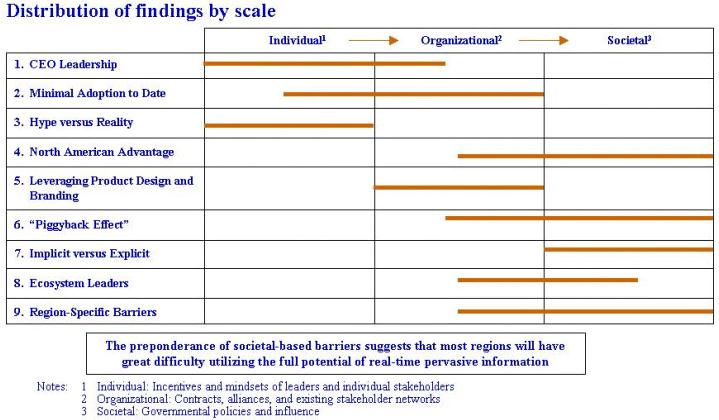
8.
There are some disablers that are unique by major geography:
Europe:
·
Government emphasis on information management leads to regulations that:
discourage business from sharing information; high compliance costs,
insistence on government access to company information, and reluctance
to establish operations in these counties
·
Existing stakeholders who will be adversely impacted by change (unions,
alliance partners, regulators, management) have power to block change.
·
Failure is punished more than success is rewarded
·
Upside for top management is limited – reduces willingness to take risks
Asia
Pacific:
·
Lack
of information transparency (gradually changing to meet foreign
investors’ demands)
·
Lack
of accepted corporate governance standards and accountability
·
Government influence on financial sector and capital allocation
·
Lack
of an “Asian” business model (Japan, China and Taiwan, Korea, etc., all
have their own models)
·
Government regulation protects status quo and discourages innovation
·
Family dominated businesses rely on implicit knowledge and have thin
management teams. Relationships with other firms rely heavily on
“guanxi” which is hard to computerize
·
Most
Asian cultures do not support high profile success and condemn failure
